

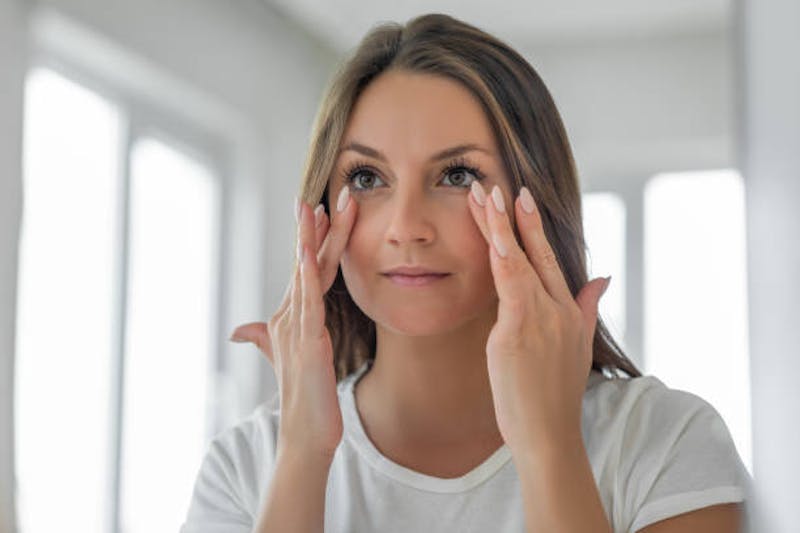
You've slept eight hours, stayed hydrated, and taken care of yourself, and people are still asking if you're tired. The answer isn't more rest. A chronically tired eye appearance is almost always structural, and it has nothing to do with your sleep habits.
What Creates Tired-Looking Eyes at Sunder Plastic Surgery in Beverly Hills
It is one of the most common things Dr. Sarmela Sunder hears during consultations: "Everyone always asks me if I'm tired. I'm not." That frustration is completely valid. When the eyes consistently communicate exhaustion regardless of how you feel or how you've slept, the cause is anatomy, not lifestyle.
Several distinct structural factors contribute to a tired eye appearance, and they don't always occur together. Correctly identifying which ones are present is the starting point for any treatment that will actually work.
The Tired Eye Look Is Structural, Not Habitual
Sleep deprivation does make eyes look less bright temporarily, but those changes resolve with rest. What brings most patients to a consultation are changes that have become permanent. They are present in the morning. They show in photographs. They do not respond to concealer, eye cream, or caffeine.
These are anatomical realities shaped by genetics, aging, and structural shifts beneath the skin. No topical product or lifestyle adjustment will correct them because their origin is not at the surface.
What Causes Heaviness in the Upper Eyelid
The upper eyelid is one of the most expressive parts of the face and one of the first places to register the effects of aging. Several mechanisms can create heaviness or hooding there.
The skin of the upper eyelid thins and becomes lax with age, accumulating as a fold that rests on or near the lid margin. In more significant cases, this tissue can partially obstruct the visual field, making it both a cosmetic and functional concern.
Beneath the skin, orbital fat can herniate or shift, adding bulk that creates a heavy, closed-looking upper eyelid. Addressing both the skin and the fat compartments during an eyelid lift produces the most open and refreshed result.
How a Descended Brow Creates the Appearance of Eyelid Problems
Brow descent is one of the most commonly misattributed causes of tired-looking eyes, and it changes the entire approach to treatment. As the brow drops from its naturally elevated position with age, it pushes skin and soft tissue downward into the upper eyelid space. The result looks like excess eyelid skin.
In many patients, what appears to be an eyelid problem is actually a brow problem. A brow lift repositions the brow back to where it anatomically belongs, opening the upper eye area without needing to remove eyelid tissue at all.
This distinction matters significantly. Performing blepharoplasty on a patient with brow ptosis addresses the wrong structure. Part of what makes Dr. Sunder's consultations thorough is this assessment: before recommending any procedure, she identifies what is actually causing what the patient sees.
Under-Eye Hollowing: Where the Shadow of Tired Lives
The under-eye area is where tiredness tends to be most legible on the face. There are two distinct problems that occur here, and they require different approaches.
The first is hollowing. As orbital fat beneath the eye diminishes or descends with age, a concavity forms between the lower eyelid and the upper cheek. This depression, called the tear trough, catches shadow and creates the appearance of dark circles and depth regardless of lighting or time of day.
Tear trough hollowing often begins in the 30s, though some patients with naturally thin under-eye tissue notice it much earlier. Under-eye treatments at Dr. Sunder's Beverly Hills practice address this hollowing through careful filler placement or, in the right surgical candidate, fat repositioning during lower blepharoplasty.
Under-Eye Bags: When Fat Protrudes Instead of Hollows
The second under-eye concern is the opposite of hollowing: protrusion. When the orbital fat that cushions the eye pushes forward against the lower eyelid rather than receding, it creates puffiness, bulging, and visible bags.
Some patients have both simultaneously. A prominent fat pad above and hollowing below creates the classic tear trough-bag combination. The bag casts a shadow directly into the hollowed area beneath it, amplifying the dark circle effect substantially and creating one of the most characteristic tired expressions.
Lower blepharoplasty with Dr. Sunder addresses this by either removing the excess fat or repositioning it into the tear trough, depending on which approach better suits the patient's anatomy. Fat repositioning rather than simple removal creates a smoother, more natural transition from the eyelid to the cheek.
Why Dark Circles Are Often a Volume Problem, Not a Pigmentation One
Many patients believe their dark circles are a pigmentation problem and have spent years reaching for brightening serums, eye creams, and concealer. In a significant number of cases, the darkness is not pigmentation. It is shadow.
A hollow tear trough casts a shadow that reads as dark brown or gray regardless of skin tone. This shadow-based dark circle does not respond to lightening treatments because there is no pigment to target.
The diagnostic clue is that the darkness shifts depending on the angle of light: true pigmentation is relatively static, while shadow-based darkness changes with lighting conditions.
When dark circles are shadow-driven, volumization of the hollow is the solution. This is a distinction Dr. Sunder identifies at every consultation because the treatment approach changes completely depending on the cause.
Can Non-Surgical Treatments Address Tired-Looking Eyes?
Yes, and for many patients, they are the right first step. The appropriate non-surgical intervention depends entirely on which anatomical factor is driving the appearance.
Tear trough hollowing in the right patient can be beautifully addressed with precise filler placement. The under-eye area is one of the most technique-sensitive regions of the face. Filler placed too superficially creates a bluish tint known as the Tyndall effect. Filler placed too densely creates puffiness.
In Dr. Sunder's hands, the result is a subtle, even correction that reads as a well-rested version of the patient, not as a treated one.
For upper eyelid heaviness caused by brow descent in its early stages, neurotoxins can provide a modest temporary lift. For patients with true excess skin or herniated fat, these non-surgical approaches improve the appearance but cannot replicate what a precise surgical correction achieves.
When an Eyelid Lift Produces the Most Lasting Result
For patients with significant upper eyelid skin excess, herniated orbital fat, or meaningful structural brow descent, surgery produces results that are more complete and longer-lasting than any injectable alternative.
An eyelid lift with Dr. Sunder directly addresses the skin and fat that accumulates in the upper and lower eyelids with a level of precision that injectables cannot reach.
For upper eyelid surgery, especially, the improvement in the field of vision often comes alongside the cosmetic benefit, making it one of the few procedures that improves both how patients look and how they see.
The eyes are where patients feel the tired appearance most acutely, and where the result of careful surgery is immediately apparent. Dr. Sunder's patients consistently describe the outcome as looking like themselves again, just without the exhaustion.
Dr. Sunder's Approach to Eye Rejuvenation in Beverly Hills
Dr. Sarmela Sunder is a double board-certified facial plastic surgeon and one of the few women in Beverly Hills with that distinction. She studied at Johns Hopkins University, earned her MD at Cornell University Weill Medical College, and served as Chief Resident at Stanford.
Her fellowship training was completed under two past presidents of the American Academy of Facial Plastic and Reconstructive Surgery, a mentorship combination rarely found in any single surgeon's background.
The Hollywood Reporter described her as "the secret behind some of Hollywood's most age-defying faces." She has been named a Top Doctor and Rising Star by Los Angeles Magazine for eight consecutive years.
Her approach to every eye rejuvenation consultation begins with the same question: What is actually creating what this patient sees? The answer determines whether the right treatment is a filler, a lift, a brow repositioning, or some combination. No two consultations, and no two treatment plans, are the same.
Patients travel from across the United States and internationally to consult with Dr. Sunder at her Beverly Hills practice. Schedule your consultation to find out exactly what is creating the tired appearance around your eyes and what can address it.
